Executive Summary
The page sells the webinar; the page also leaks the lead
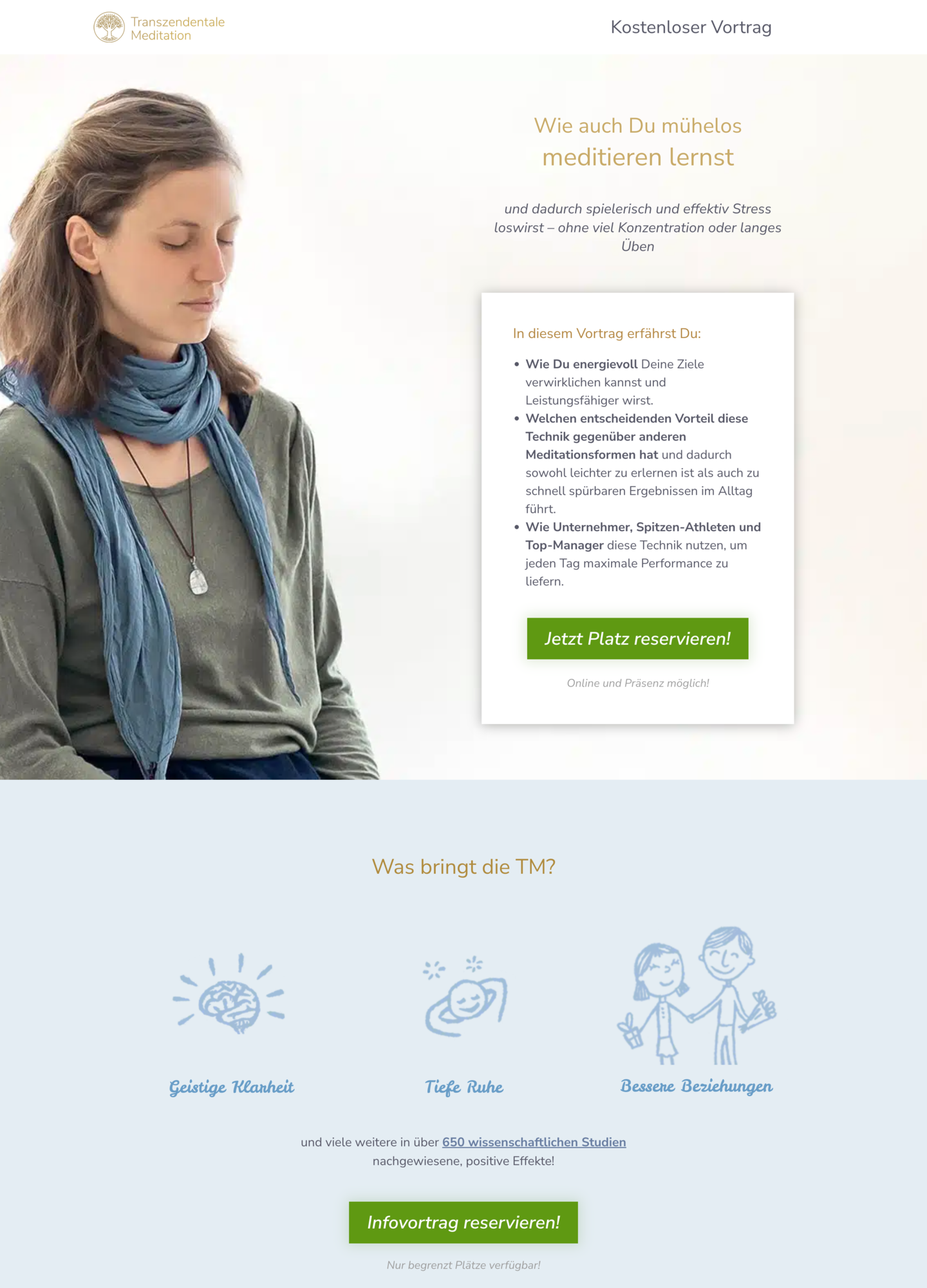
Meditation.de earns the click with a strong promise (“Wie auch Du mühelos meditieren lernst”),
a clean 3-bullet preview card, and a green primary CTA that's instantly legible. But three structural problems
drag the registration rate well below where this asset deserves to be. One: the strongest trust signal
on the page — Stanford / Yale / Harvard / NIH — is buried below the hero instead of stacked
underneath the CTA where skeptics make their decision. Two: every one of the 16 named instructors gets a
phone number AND a personal “E-Mail senden” button, which means motivated visitors have a
path around the lead-capture funnel — the page is teaching them how to escape it. Three:
the actual conversion buttons (the per-date reservieren CTAs and the modal weiter) are in
low-contrast brown italic, while the page has trained the eye to look for green.
Top priority · Expected lift band · Biggest risk
- Top priority: Plug the instructor-section lead leakage (Rec 2). Every direct phone & email
link is a registration that didn't happen — on a free-webinar funnel, this is the single largest lever
on the page.
- Expected lift: Recs 1–7 non-overlapping registration-rate band estimate:
~3–8% baseline → ~4.0–10.5% conservative / ~5.0–12.5% optimistic
(+30% to +55% relative lift). Framed as registration-rate bands only — we did not have actual
traffic, baseline, or attribution data to convert this into euros. The 3–8% band reflects typical
free-webinar TOFU conversion; once the client provides their real number we can re-anchor the math in a supplement.
- Biggest risk if ignored: The page works well enough for warm/branded traffic
because the brand is strong. On cold paid traffic, the same page underperforms because every friction
point compounds: no above-the-fold authority → trust gap → visitor scrolls past the CTA →
visitor reaches the instructor directory → visitor exits via phone/email and is never tracked. Cold
CAC will be 30–60% higher than it should be until the leaks are sealed.
Scope note: This audit covers three artifacts the client provided: (1) the full landing page at
meditation.de/tm/?center=226, (2) the per-date scheduling section that appears after the hero CTA is
clicked (jump-anchor to #vortrag), and (3) the 3-step opt-in modal that opens when a specific webinar's
reservieren button is clicked (only step 1 of 3 was provided). Out of scope for this pass:
the post-registration confirmation/thank-you page (no screenshot supplied), the live webinar content itself, the
paid TM teacher-training upsell that presumably follows the webinar, and the upper-funnel ad creative driving
traffic to this page. A handful of recommendations name the back-end as context for what the LP should
prepare the visitor for — but no recommendation here changes the back-end.
Evidence sources in this report: Every exemplar below is tagged by its provenance:
Scraped page = a real, live page from our
scraped library — click to expand the full capture.
FOTW article = a screenshot from the FOTW
breakdown article (a section, not a full page).
FOTW video frame = a frame captured while
the FOTW host reviewed someone's funnel on video. Per the project's #1 rule (No Theory Without Evidence) we prefer
scraped pages; article shots and video frames are labelled honestly so you can judge them.
Phase 0 — Observations
Eight things the page tells us on its own
Each observation is cross-checked against a specific chunk of the live capture
(lp-chunk-NN.png in assets/) plus the user-provided scheduler and modal screenshots.
Direct German quotes included where the copy is diagnostic.
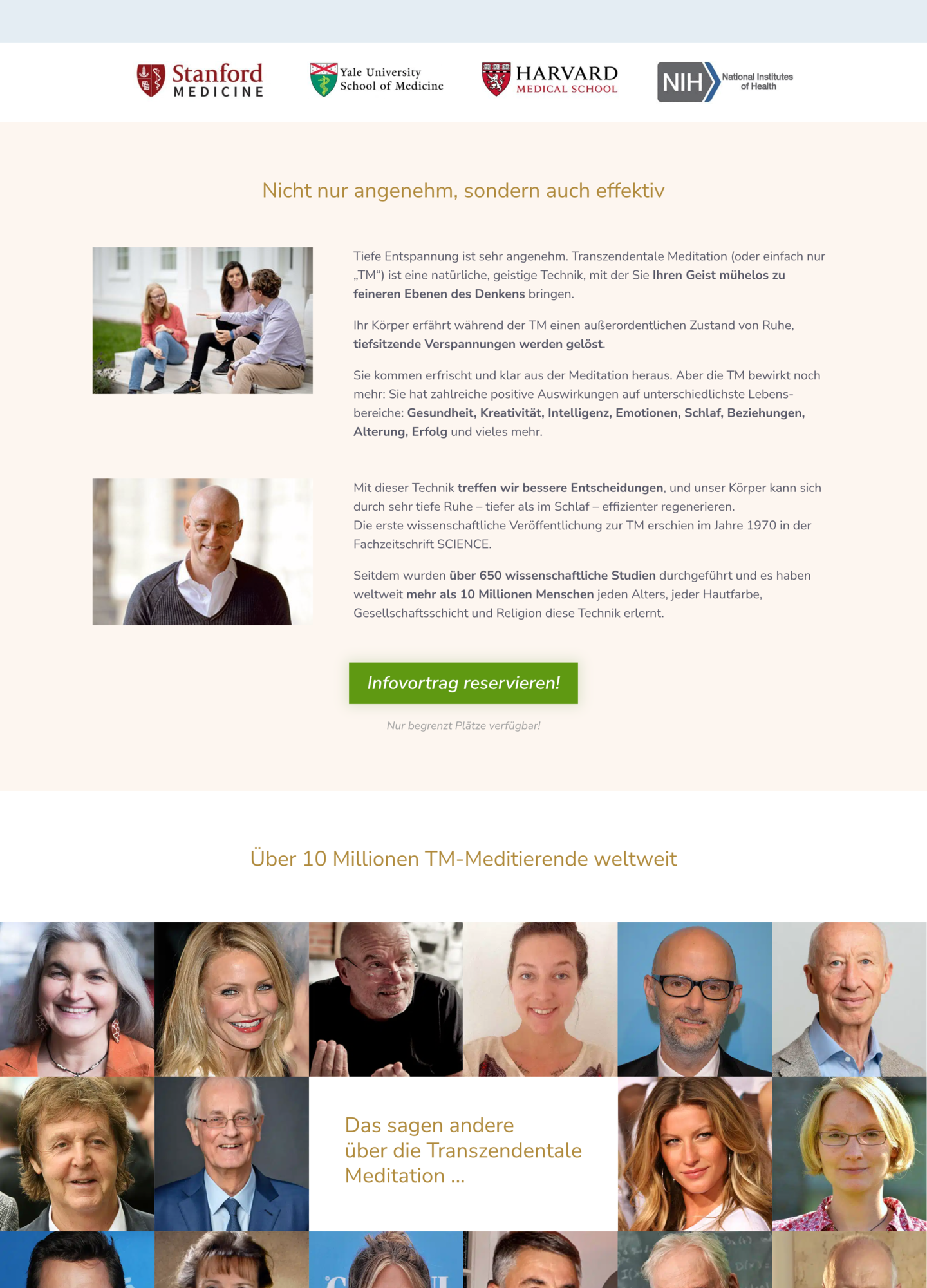
Observation 1 — The university authority bar (Stanford / Yale / Harvard / NIH) is buried below the fold
The single most credibility-rich asset on this page is the row of four medical-school logos
(Stanford Medicine, Yale University School of Medicine, Harvard Medical School, NIH). It is
where most of the page's research authority is concentrated. Yet it doesn't appear until chunk 01
— below the hero, below the 3-icon benefit row, below the second CTA. The visitor who is most likely to
churn off a meditation page is the skeptic asking “Ist das eine Sekte?” — they
decide in the first 5–10 seconds. Putting the heaviest credibility load right next to the hero CTA
would resolve that 5-second decision in the brand's favour. (See lp-chunk-00.png for the
current hero, lp-chunk-01.png for where the logos actually live.)
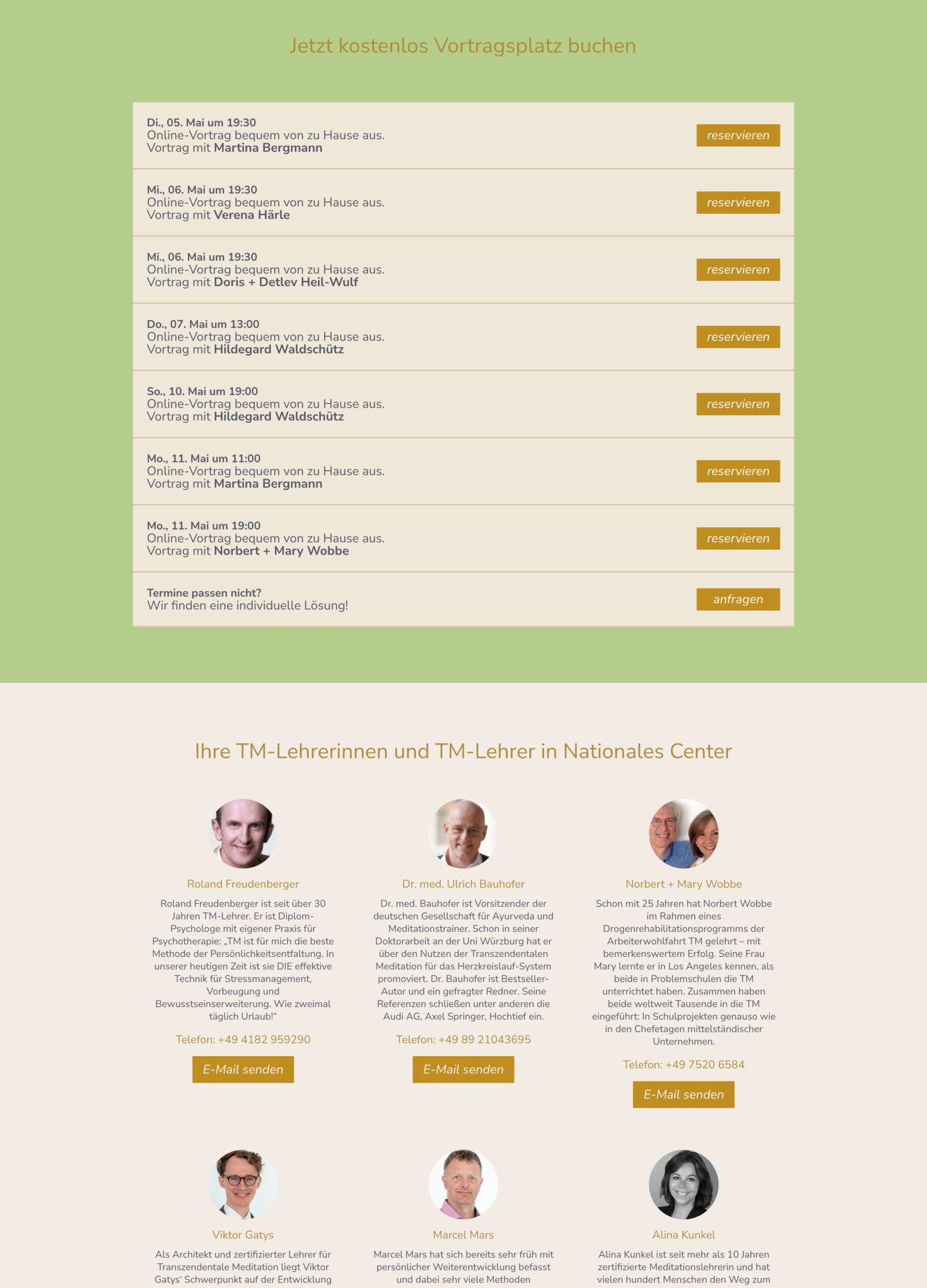
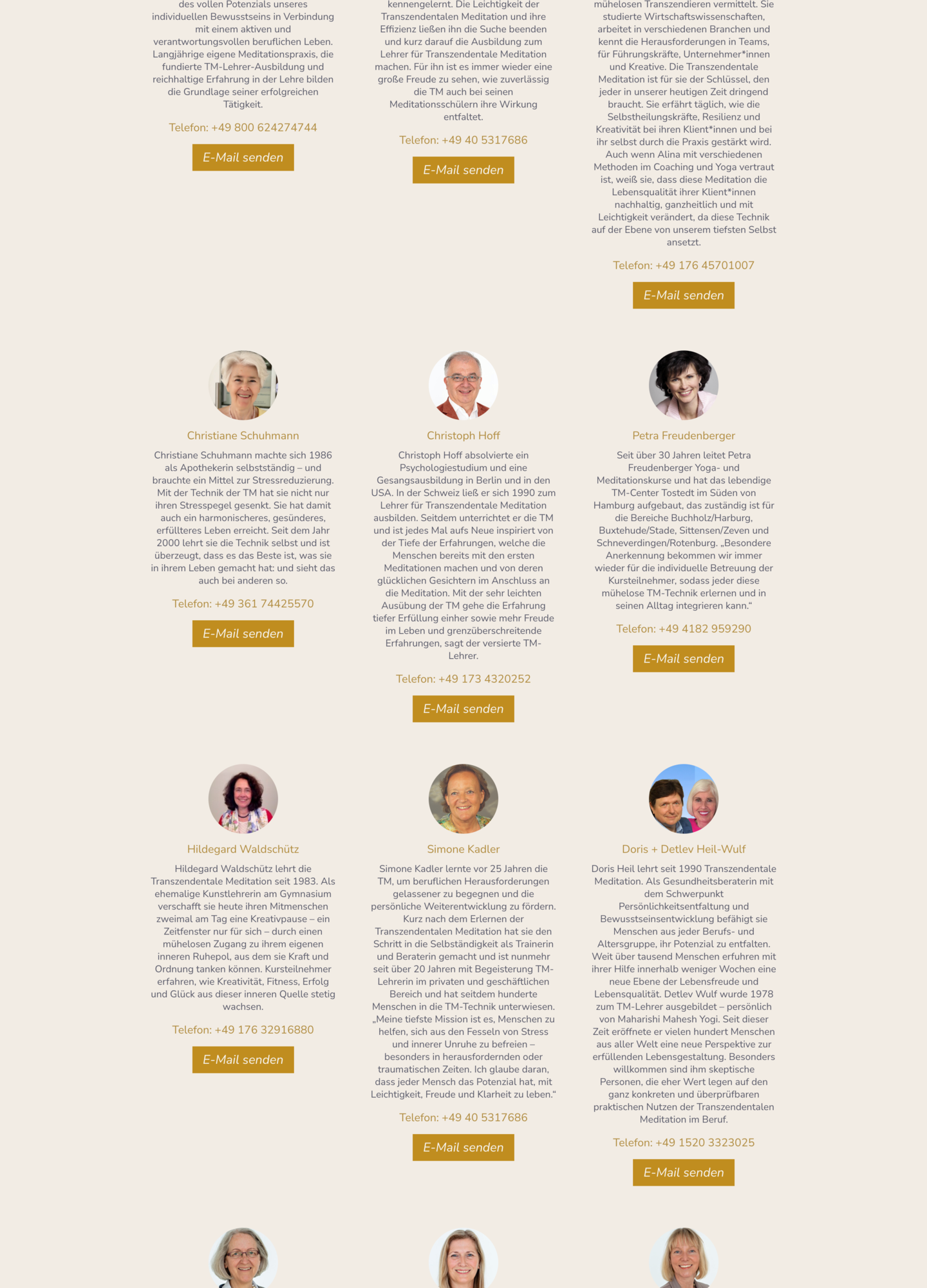
Observation 2 — Every instructor has a personal phone number and “E-Mail senden” button. The directory is teaching visitors how to bypass the funnel.
Sixteen named TM teachers occupy chunks 03–05. Each card displays the teacher's photo, a
paragraph bio, a direct phone number (Telefon: +49 ...), and a personal
“E-Mail senden” button. From the brand's perspective this signals warmth and approachability.
From a funnel perspective, this is the largest single lead leakage on the page. Every motivated visitor who
calls or emails a teacher directly is a registration that didn't happen, a CRM record that wasn't
created, an automated nurture sequence that won't fire, and a pixel that didn't track. For a TOFU lead-gen
asset, the directory is structurally an exit ramp. (See lp-chunk-03.png, lp-chunk-04.png,
lp-chunk-05.png.)
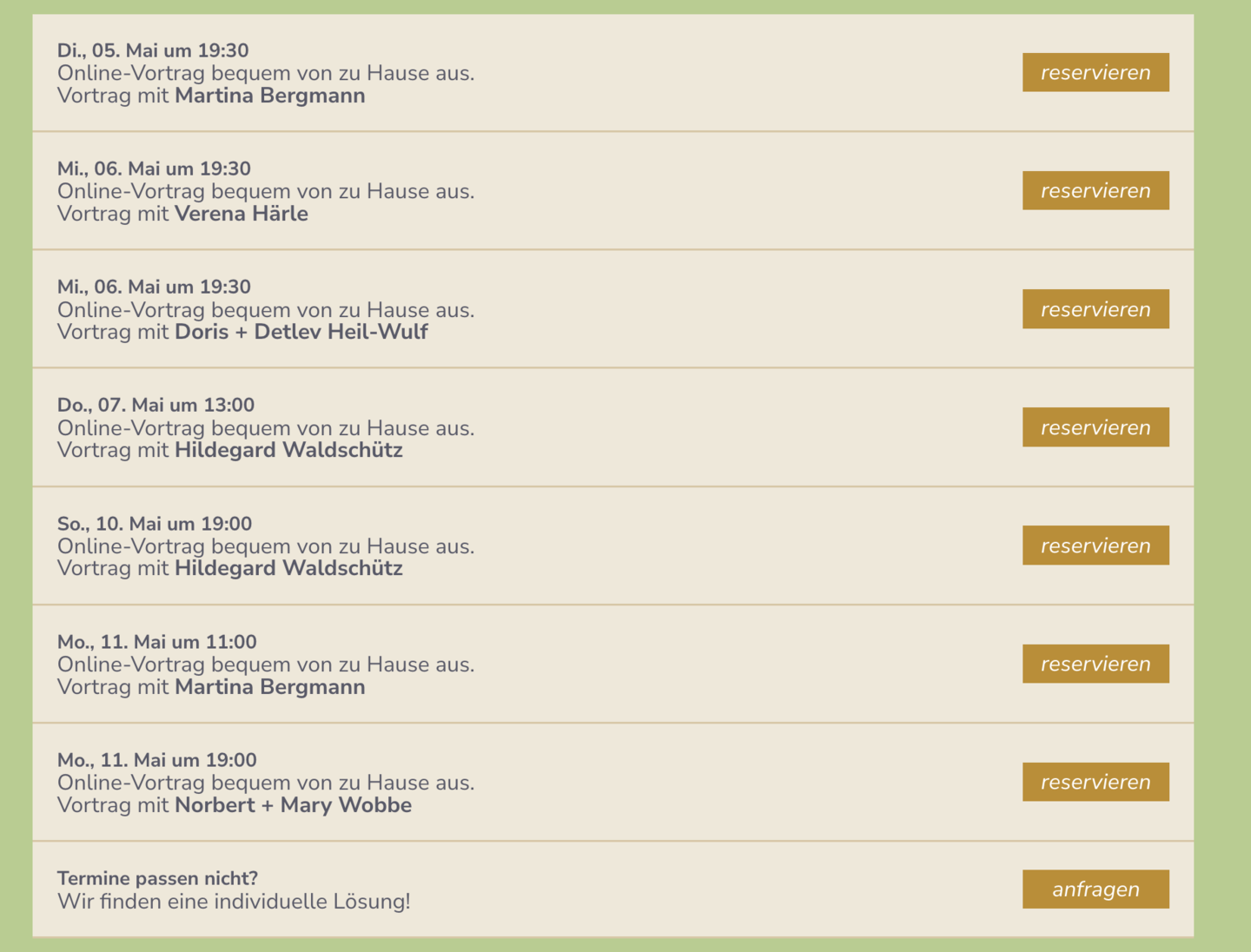
Observation 3 — The actual conversion buttons aren't green. The hero trains the eye, then the conversion buttons betray it.
The page has a clear visual hierarchy: green = primary action. The hero CTA
“Jetzt Platz reservieren!”, the “Infovortrag reservieren!” that fires four
more times down the page — all in the same green button. Then the visitor reaches the actual
scheduling section and the buttons turn into brown italic reservieren that read
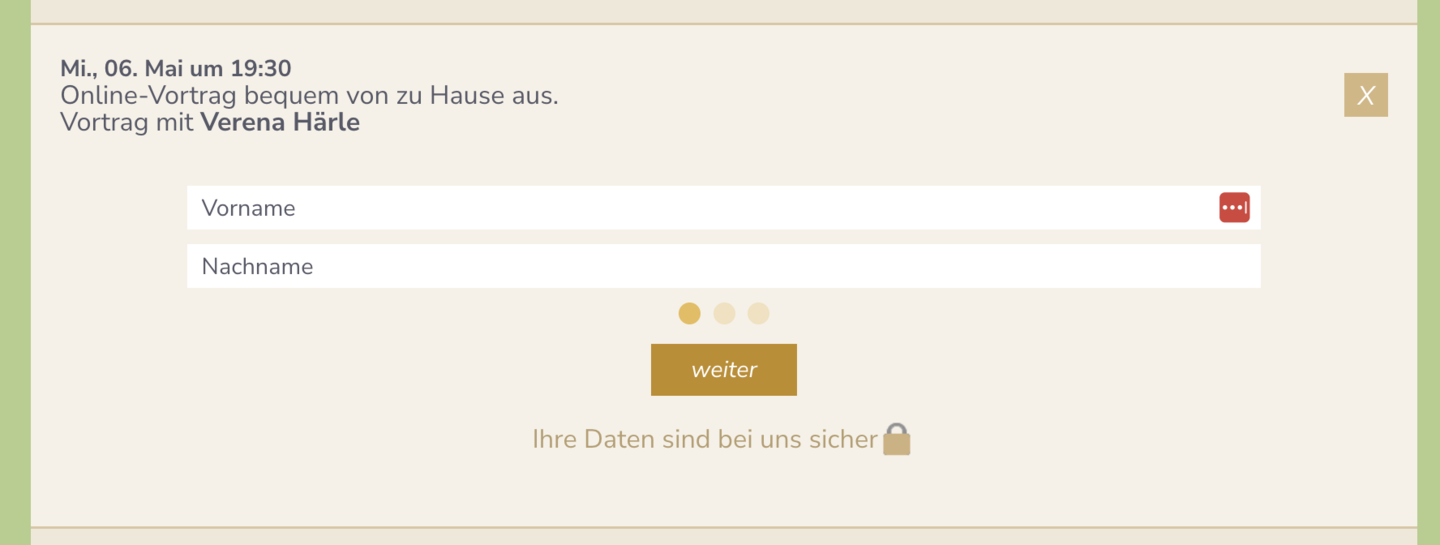
like links rather than CTAs. The modal step 1 shows the same problem: a brown italic weiter.
The visitor's eye has been trained to look for green; the points where the conversion actually
happens are not green. (See scheduling.png and modal-step1.png.)
Observation 4 — The 3-step opt-in modal asks for the wrong field first and hides the rest of the form behind dots
Step 1 of the modal asks for “Vorname” and “Nachname”. Below sits
a 3-dot indicator (one of three highlighted) and the brown italic weiter. There is no
“Schritt 1 von 3” language. There is no disclosure of what steps 2 and 3 ask for.
A visitor at the moment of highest commitment-anxiety sees three unnamed dots and has to assume the worst:
credit card? phone call? a sales pitch? Two structural problems compound here: (a) name is the
weakest possible field to lead with — email is the field the brand actually needs
to send the access link, and putting it second means visitors who abandon mid-form give the brand nothing;
(b) the dots without disclosure read as deceptive even though they aren't. The
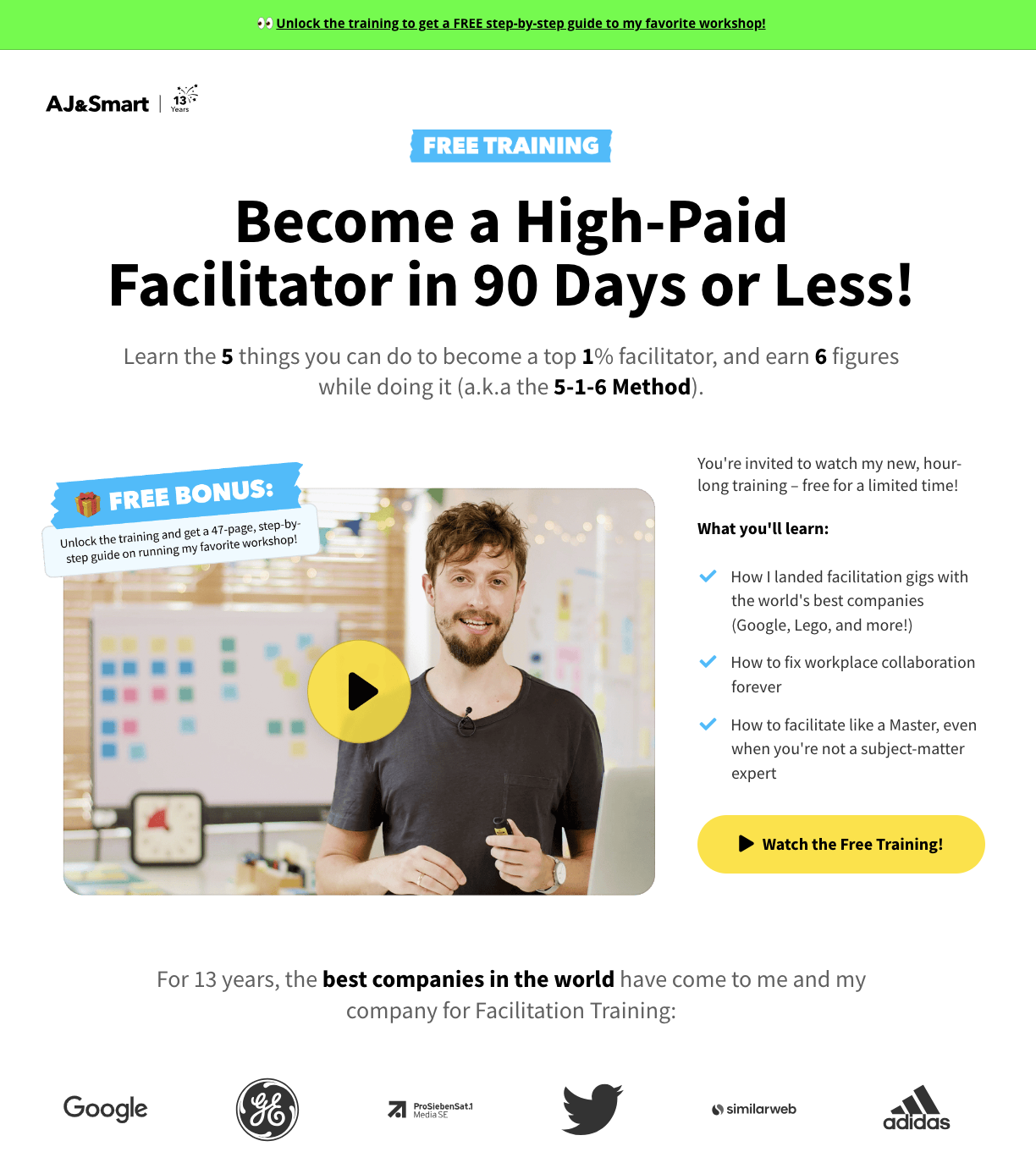
bonus-enhanced-optin pattern from AJ&Smart's $252k/mo funnel is explicit on this: “Keep the
optin form simple — Name and email only.” (See modal-step1.png.)
Observation 5 — “Nur begrenzt Plätze verfügbar!” is everywhere and nowhere
The phrase “Nur begrenzt Plätze verfügbar!” appears under five
different green CTAs across the page. The intent is honourable — create urgency to register today
rather than “maybe later”. The execution undermines it: tiny tan-on-cream microcopy at roughly
11–12px, no border, no badge, no per-event count. From a normal viewing distance the copy is
functionally invisible. Either delete it (if seats aren't actually limited) or make it visible: per-event
“Noch 7 Plätze frei” live counters, or a banner above the calendar. The current
state is the worst of both worlds — legally implies scarcity, visually delivers none. (See
lp-chunk-00.png, lp-chunk-01.png, lp-chunk-02.png, lp-chunk-05.png.)
Observation 6 — The scheduling section forgets to remind visitors what the webinar is about
Above the hero CTA, the page does an excellent job of selling why to attend (“In diesem
Vortrag erfährst Du: Wie Du energievoll Deine Ziele verwirklichen kannst...”, the 3 icon-benefit
row, the 4-logo authority bar). Then the visitor scrolls to the actual scheduler and sees seven identical rows
of “Online-Vortrag bequem von zu Hause aus. Vortrag mit [Name]” — same generic
line-item every time. The one moment in the funnel when commitment is being asked, the page goes generic.
A short “Was Du im 60-Min-Vortrag lernst” recall right above the calendar —
mirroring the hero's 3 bullets — would re-prime the decision at exactly the moment it matters.
(See scheduling.png.)
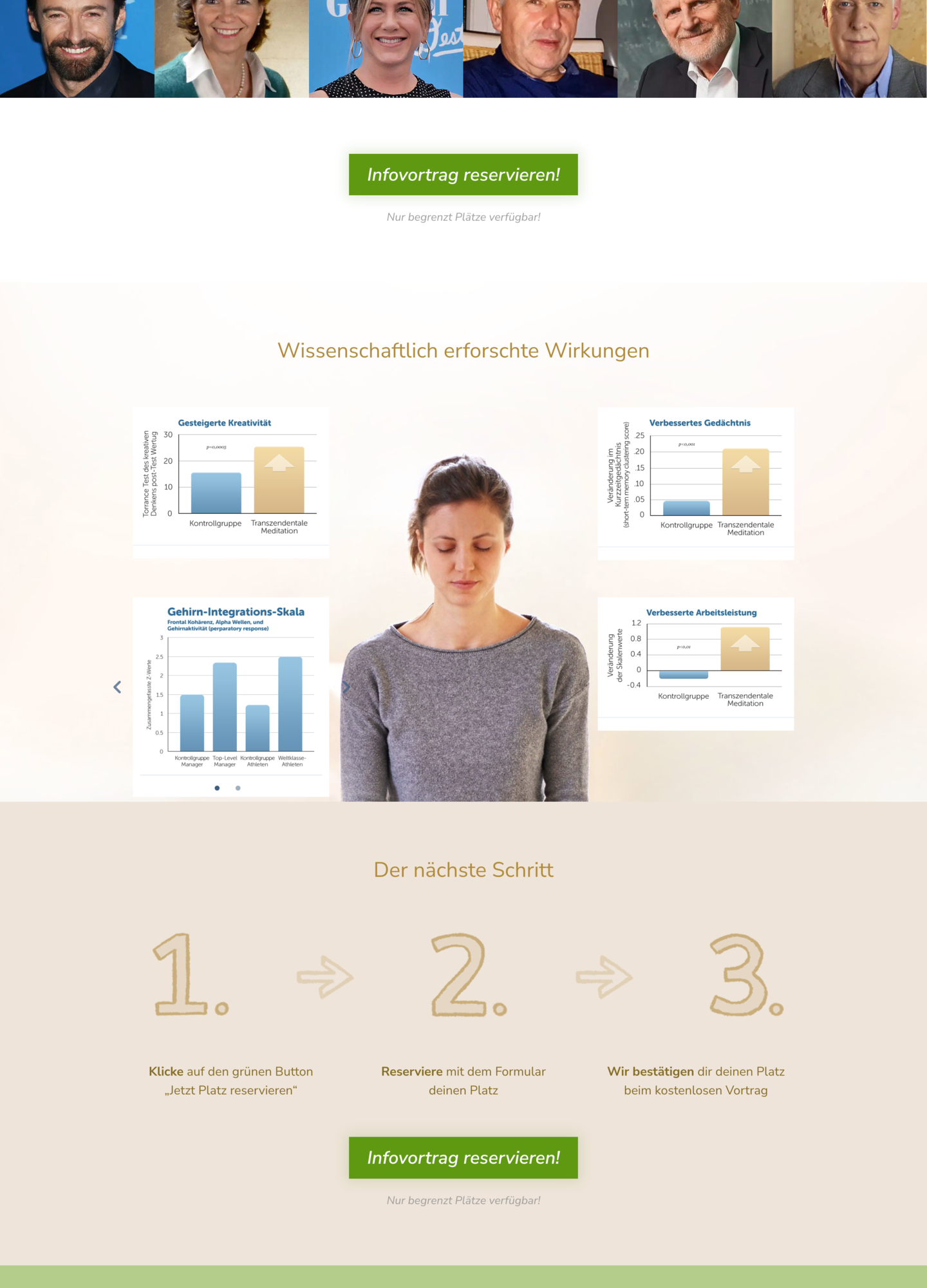
Observation 7 — The science charts are decoration, not data
The “Wissenschaftlich erforschte Wirkungen” section shows four small bar-chart
thumbnails arranged decoratively around a central portrait of a woman meditating. The chart axis labels
are illegible at default zoom; the visual reads as “wir haben Wissenschaft” rather than
communicating any specific finding. For a sceptic audience this is a missed opportunity — the page
has 650+ peer-reviewed studies to cite and chooses to show four pretty thumbnails. Three large stat
callouts citing a specific journal and year would do more work in less space. (See lp-chunk-02.png.)
Observation 8 — The narrative architecture is excellent — the problem is layering, not story
Credit where credit is due. The hero card “In diesem Vortrag erfährst Du” is a clean
3-bullet preview promise. The 3-step “Der nächste Schritt” visualization is exactly
the friction-reducer a sceptical audience needs (“Klicke → Reserviere → Wir bestätigen
dir” — explicit, low-stakes, low-commitment). The modal preserves the date and presenter at
the top (“Mi., 06. Mai um 19:30 · Vortrag mit Verena Härle”) which provides
continuity between scheduler and form. Sixteen genuinely credentialed instructors with photos signals real
institutional depth. The brand visual system (cream / sage / serif italics) reads as calm and credible.
The page doesn't need a redesign. It needs authority moved up, leakage closed, and the conversion
buttons made green. (See lp-chunk-00.png for the hero, lp-chunk-02.png
for the 3-step, modal-step1.png for the persistent date header.)
Registration Lift Thermometer
Expected registration-rate lift per recommendation
Framed as registration-rate bands against an assumed 3–8% baseline — the typical
free-webinar TOFU range — not against a verified client baseline (which the client did not provide).
Bars show the expected lift on the assumed band. Bands do not stack linearly; some lifts compete for the same
visitor segment. Treat the aggregate as a directional unlock, not a forecast. Once the client
supplies actual traffic + reservation data, this thermometer converts directly into per-day registration counts.
Rec 1 — Move Stanford / Yale / Harvard / NIH bar above the fold+0.4–0.8pt
Authority is the gate for skeptical visitors deciding in the first 5 seconds. The asset already exists — only its position needs to change.
Rec 2 — Replace direct phone/email links in the instructor section with “Vortrag mit [name] reservieren”+0.5–1.5pt
Single biggest lever. Every direct contact path is a registration that doesn't reach the CRM. Wide band reflects unknown current leakage volume; this should be measured before/after.
Rec 3 — Make every conversion button (scheduler & modal) green+0.2–0.5pt
Pure visual hierarchy fix. The eye is already trained on green; honour the training at the moment of conversion. CSS-only change.
Rec 4 — Modal: ask email first; disclose “Schritt 1 von 3” with what's coming+0.3–0.6pt
Email-first means abandoners still leave the brand a usable contact. Step disclosure removes the “what am I signing up for?” friction at the dots.
Rec 5 — Make “Nur begrenzt Plätze verfügbar” actually visible (per-event count or banner)+0.2–0.4pt
Either deliver the scarcity visibly or remove the claim. Per-event counters (live or evergreen rollover) are the standard pattern.
Rec 6 — Add “Was Du im 60-Min-Vortrag lernst” recall above the scheduler+0.15–0.3pt
Re-primes the decision at the moment of commitment. Mirrors the hero's 3 bullets so the visitor sees the same promise twice, in two different forms.
Rec 7 — Replace decorative chart-quartet with 3 readable stat callouts+0.1–0.25pt
Lower-confidence rec. Decoration → data: each callout cites journal + year + finding. Compounds with Rec 1 (authority stack).
Aggregate (recs 1–7, non-overlapping estimate)
Assumed baseline 3–8% → ~4.0–10.5% conservative / ~5.0–12.5% optimistic
· i.e. +30% to +55% relative lift on registration rate.
Bands do not stack linearly — Rec 2 (lead leakage) is the largest single lever, Rec 1 (authority above
the fold) is the gate that conditions the effect of Recs 3–7. Treat as directional, not forecast. Once
the client provides their measured registration rate + traffic volume we can re-anchor this on real numbers
and convert it to per-day registration deltas.
Library Gaps Honestly Flagged
Three places we cited a closest-analogue rather than a perfect-fit exemplar
Gap 1 — No scraped exemplar of an instructor directory that routes contact through the funnel:
Rec 2 (the highest-leverage rec in the report) leans on the webinar-to-call-architecture pattern's
general principle (every CTA funnels into the same booking flow) rather than a specific scraped page that
shows a wellness/info-product instructor directory using "[name] reservieren" buttons. Action: when this
change ships and we measure the lift, capture the new state and add it to the library as the canonical
exemplar.
Gap 2 — No scraped exemplar of a live-event scheduler with per-event capacity counters:
Rec 5 (visible scarcity) cites checkout-optimization/countdown-price-decay as the closest pattern,
but that pattern lives on checkout pages, not webinar schedulers. We should scrape 2–3 wellness/coaching
webinar schedulers (Mindvalley, Calm, ClassPass-style live-event listings) to fill this exact gap.
Gap 3 — No client baseline data: The thermometer is a band-based estimate against an
assumed 3–8% free-webinar registration rate, not a verified client baseline. Three numbers turn this
into a forecast: (a) measured registration rate today, (b) monthly traffic to /tm/?center=226,
(c) traffic-source mix (cold paid / warm branded / organic). Once those exist we re-anchor the math and
issue a supplement — the same format as the Hike Footwear and Mana triages.